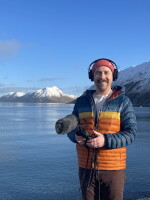
When John Blanchard started fishing out of Charleston in 2007, wooden salmon boats came in from out of town and tied up for the summer. He used to sell tuna right off his boat at slip D-63. This fall, the slip was empty.
These days he sees more sailboats and more empty slips. On a walk down D Dock, Blanchard pointed out a steel ring that held a floating dock against a piling as the tide rose and fell. A piece of rust came off at a touch. Farther down, one of the wooden dock fingers was tilted off its axis, the wood warped with age.
“The dock itself is twisted up and is at almost a 45 degree angle,” he said. “You couldn’t offload fish here. You can barely walk on it.”
By his reckoning, D Dock is still one of the better docks they have.
The International Port of Coos Bay, the Oregon special district that runs the marina, is pursuing a multibillion-dollar shipping terminal called the Pacific Coast Intermodal Port. Port leaders say the terminal could bring in revenue to help repair the marina and shipyard. Charleston fishermen say breakdowns are already costing them work and they need those repairs now.
Grievances
On a Wednesday morning in late October, fishermen gathered at an office down at the harbor, across the road from the Coast Guard station. Melissa Clemens, president of Charleston Fishing Families, had rallied the fleet ahead of a port advisory meeting.
“The whole fleet is tired of waiting,” Clemens said. “We have been put on the back burner for every other project that the International Port of Coos Bay has, and we’re done.”
Clemens said her crew had missed a three-day halibut opening that summer. The fuel dock was out of fuel, she said, and the ice plant was down. The crew couldn’t leave without enough ice to keep the catch cold. She figured her boat lost about $30,000 in revenue.
The port rebuilt the ice plant after a fire destroyed the old one in 2019. The replacement opened the following September, paid for with insurance proceeds and state loans.
People passed around printouts from port commission meetings. Ray Cox, who owns Giddings Boatworks at the Charleston Shipyard, pointed to a paragraph that said a prior year’s surplus had gone to railroad expenses.
“We speculated it’s going somewhere besides here,” Cox said.
In June, the port commission reduced what Charleston was authorized to spend by nearly $400,000. The port shifted spending authority within its general fund, drawing from Charleston, administration and debt service to cover railroad insurance and help the Coos Bay Rail Line pay operating expenses, according to a port staff memo.
It was the fourth consecutive year commissioners reduced Charleston’s spending authority in budget adjustments that made more room for railroad expenses. The reductions added up to nearly $1.2 million.

The shipyard is crucial for the fishing fleet. The day before the meeting was one of the highest tides of the year, which is helpful to lift boats out of the water because the equipment used to haul them isn't fully operational. But even on the high tide, Cox said he couldn't get a vessel needing repair onto land.
Craig Stolz, another fisherman at the office, said there was a hole in the bottom of his shrimp boat. He figured he needed about $50,000 in repairs but would have to take the boat to Toledo for the work.
“I’m not going to be able to give it to this guy or this community,” he said.
The fleet makes its case
It was standing room only when about 40 fishermen and maritime workers crowded into the marina’s recreation room for the Charleston Marina Advisory Committee, a group of fishermen, business owners, scientists and other stakeholders who make recommendations to the port's board of commissioners.
The meeting quickly got contentious as fishermen and other maritime workers poured out their concerns.
A fishing crew missed an entire halibut opener because the marina’s ice plant broke down. A shipyard worker said he fears for his safety. And Ray Cox said the deteriorating equipment at his shipyard is preventing him from hauling out boats for repairs.
They all want answers.
Port staff said they had applied for an emergency permit to repair the shipyard equipment. They also planned to rebuild the marina's ice machine during a November maintenance shutdown.
"What I don't understand is why is our money going to the railroad?" Giddings Boatworks owner Ray Cox asked the board.
Port CEO Lanelle Comstock explained that the port is not taking Charleston’s revenue, like moorage or insurance, to prop up the railroad. She says Charleston historically has often needed financial support from the port, not the other way around.
“Charleston has always operated at a loss,” Comstock said. “So to take money from Charleston ... Charleston didn't have money to take from.”
Comstock said Charleston and the railroad draw on the same general fund. She said revenue from other port departments had helped cover Charleston’s operating losses in previous years. In June, she said, the port used general fund money to pay outstanding bills the railroad owed vendors.

The advisory committee voted unanimously to send port commissioners a letter asking the port to estimate the cost of overdue repairs and set aside money for Charleston that it would protect from future transfers.
Two visions
The port commissioned a strategic plan in 2025 to outline the port's priorities. The plan calls for revitalizing the marina and shipyard, and describes Charleston as being at a “tipping point.”
So John Blanchard, the fisherman who pointed out repairs needed on the docks, was shocked when he watched the port commission's June meeting on YouTube and heard commissioners shift money out of Charleston’s budget.
“I had to rewind it and I had to listen to it again,” Blanchard said.
He said the decision made him question how much weight commissioners give the public input they solicit.
"They come up with the strategic business plan, but then literally six people decide that they're not going to follow the strategic business plan or the the wishes of the public who actually live here today," he said.
Port CEO Lanelle Comstock, who lived in Charleston when she first moved to Coos Bay in the early 2010s, said she would discuss the committee’s request for dedicated funding with commissioners and the port’s finance staff.
The port is an Oregon special district, a local government that also operates businesses. It owns industrial land and a railroad, along with the marina, shipyard and RV park at Charleston. It can levy property taxes, develop facilities and lease property.
Moorage fees, RV park receipts, property taxes and income from port leases go into the general fund. For the fiscal year that started in July, the port projected about $2.8 million in operating revenue from Charleston and about $2.2 million in property taxes across the district. Commissioners authorized about $8.3 million in general fund spending. Most of the overall $61.7 million budget is in a separate fund for major projects.
Oregon budget law lets commissioners change how much each department can spend when expenses come up. It’s part of what a general fund is for. In this case, the budget votes show how much spending authority the commercial fishing facility at Charleston lost.
Years away
Comstock said the port has sought funding of nearly $12 million for marina and shipyard improvements since 2024 and has secured $1 million in federal funding for the shipyard.
The port’s last two applications for state transportation grants and its last two congressional funding requests targeted Charleston, said Matt Friesen, the port’s director of external affairs.

Comstock said a permanent fix for the marine ways could take until fall 2028, even if the port secures the remaining funding. The port still needs permits, and construction can only take place during a limited window for in-water work.
Port Commission President Kyle Stevens, who grew up in Coos Bay, says maintaining the infrastructure Charleston already has will require new sources of revenue. And he believes the international port expansion could provide that.
“All of us want to see the next big thing that creates a bunch of jobs and pays a bunch of taxes and slides a bunch more money into operations for the port, so that we can fund everything,” Stevens said. “It’s that next project that's going to, at least it’s my belief, that's going to help us develop our way out of here.”
Expansion projects are central to how a port operates. Oregon law makes development at port districts a priority for the state’s economy.
Stevens says the port is trying to create a new economic engine to help sustain the industries already here.
But the fishermen say those industries need help now. And they fear that by the time the port's new economic engine is up and running, there won't be much of a fishing fleet left to sustain.